lioniq
Case Study — EdTech / AI — MVP Stage
LIONIQ — AI Speaking Platform
Co-founding and designing an AI speaking coach that lets IELTS candidates practice real exam questions by voice — with instant AI-driven transcription, scoring, and feedback.
ROLE
Product Design Lead (Co-founder)
Product Type
EdTech / AI
Timeline
2025 – Present
Stage
MVP
LIONIQ helps IELTS candidates practice real exam speaking questions by voice. The AI transcribes each response, scores it against IELTS criteria, and gives instant, actionable feedback — turning speaking practice into something learners can actually improve from on their own, without waiting for a tutor or a test day.
I’m the Product Design Lead and co-founder, owning the product from strategy through MVP — research, UX, and design direction — working directly with a small founding team to get the first version into learners’ hands.
This is currently at the flow-and-wireframe stage — I designed the user flow on paper, directed AI-generated wireframes to test it against real scenarios, and refined it with the development team. High-fidelity UI is the next phase.
01
Overview
Most speaking practice is either silent rehearsal with no real feedback, or expensive private tutoring just to find out how you’re actually scoring. Neither lets a candidate practice consistently and see exactly what’s holding their band score back.
An early AI-generated MVP already existed when I joined this stage — a working prototype with the core recording-and-feedback loop in place. My job wasn’t to design from a blank page; it was to treat that MVP as a first draft, audit it against real user needs, and turn it into a product people would actually trust with their exam prep.
02
The Problem
1- Practice a real question. The learner is given an authentic IELTS speaking question to answer out loud.
2- Record their answer. They respond by voice, just like in the real exam.
3- AI transcribes & scores. The response is transcribed and scored against IELTS speaking criteria.
4- Instant feedback. The learner gets a score and specific feedback on what to improve — immediately, not days later.
03
How It Works
I drew on my own experience taking the IELTS exam, plus informal conversations with other candidates, to pressure-test where a band score alone falls short. Three patterns kept surfacing:
Candidates want the specific cause behind a score — a pause, a wrong word, a mispronunciation — not just a number. Many walk in expecting a higher band than they receive, based on self-perception rather than a real baseline, and are discouraged when the real result lands lower. And the cost of private tutoring is a recurring, genuinely felt pain point — the main reason candidates turn to a product like this in the first place.
These findings, not assumptions, drove every priority decision that followed.
04
Research
Before touching any screens, I audited the existing MVP the way I’d audit a competitor product — running it against usability heuristics rather than assuming a polished build meant a validated one.
In parallel, I designed the user flow on paper — from sign-up through to a target band — based on the research findings above, not the existing code. I then directed AI-generated wireframes to visualize that flow, reviewed them against real candidate scenarios, and worked with the development team to refine the flow until it held up.
That process surfaced two moments where confidence consistently drops: right before recording an answer, and right after seeing the score. Every design decision that followed was weighed against those two moments first, and translated into a prioritized backlog rather than a general sense of “this needs work.”
05
Design Process
1- A baseline check before anything else. Candidates often expect a high score based on how confident they feel speaking, then feel blindsided by a lower real result. A short, low-stakes diagnostic — explicitly framed as a starting point, not a verdict — moves that reality check earlier and lowers its emotional cost.
2- Transcript over playback. Candidates described replaying their own recording repeatedly just to find where they went wrong. Reading is faster to scan than listening, so the highlighted transcript — not audio replay — is the primary way to locate a mistake, with playback kept as a secondary option.
3- Recommended, not just browsable. Letting candidates freely pick a topic and part is necessary, but it isn’t the core value. A “Recommended for you” path, built from each learner’s actual weak criteria, is what turns a question bank into a coach.
06
Key Decisions
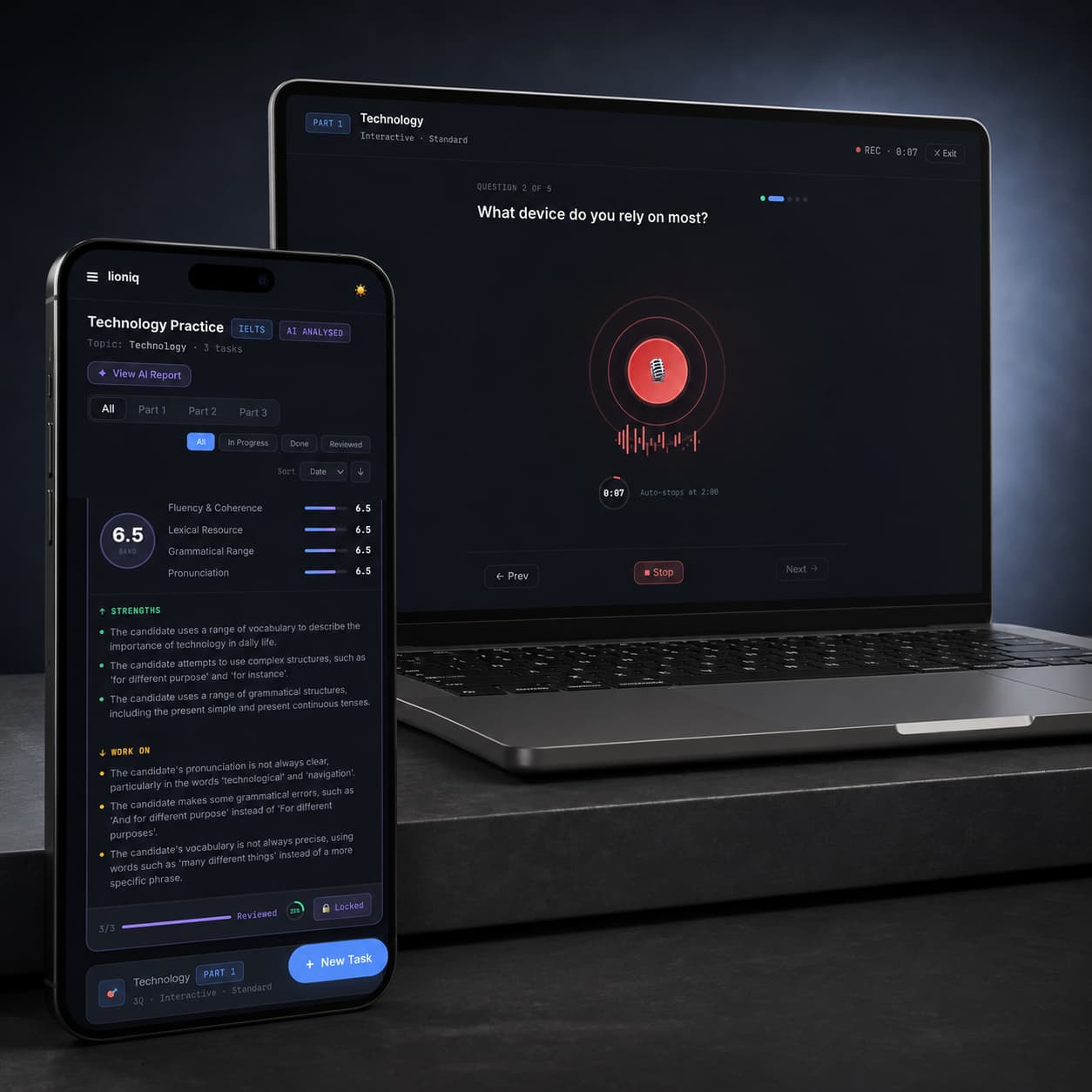
The feedback wireframe breaks the band score down by IELTS criterion — fluency, lexical resource, grammar, pronunciation — and highlights the exact word or phrase behind each deduction directly inside the transcript, color-coded by error type. From there, the learner is routed straight into a focused practice task built around their weakest criterion, closing the loop between diagnosis and action.
The recording flow includes a dedicated one-minute preparation state for Part 2, matching the real exam’s structure — something the original MVP was missing entirely.
07
Solution
The current build is scoped deliberately small: enough for five real IELTS candidates to complete a full practice loop — set a target, record an answer, and receive feedback — without the added complexity of a full mock-test mode or a personalization engine. The goal of this round isn’t to prove the product works; it’s to find out whether the feedback itself tells learners something they didn’t already know.